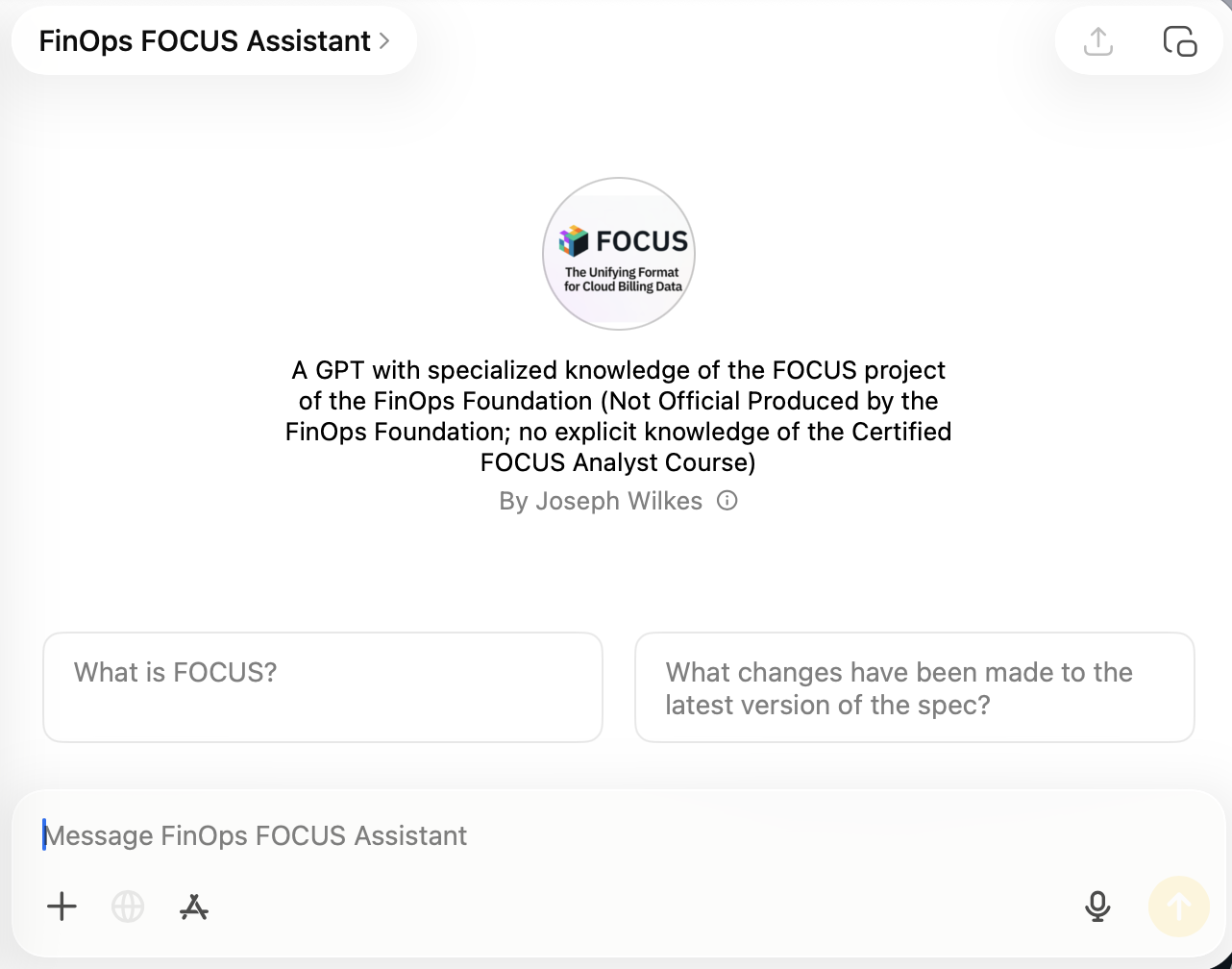
A real screenshot of the GPT interface, showing the assistant as it was shared with the FinOps community rather than relying on a generic thumbnail.
In August 2025, Joey Wilkes and I built and shared a custom GPT for the FinOps community after hearing recurring adoption and onboarding friction around FOCUS. The goal was simple: use the public material already available at focus.finops.org and the specification PDF to create a free, low-friction way for practitioners to ask questions and learn faster.
In a FOCUS contributor member meeting, the adoption problem was clear: people wanted to contribute, teach, and practice against the standard, but the barrier to entry was still too high. The official material was strong, but not always easy for newcomers to interrogate conversationally. We treated that as a practical product problem, not just a documentation problem.
We shared it with a direct ask to the community: try it, post your best and worst prompts, and tell us where it failed. That mattered. The point was not to declare victory; it was to validate whether conversational access could help onboarding and standards adoption.
A real screenshot of the GPT interface, showing the assistant as it was shared with the FinOps community rather than relying on a generic thumbnail.
The early responses were useful because they were specific. The feedback showed both the promise and the weaknesses of a first-pass GPT built on public spec material.
This project shows the operating pattern I care about: listen to the friction, build a practical artifact quickly, release it to real users, and use their feedback to learn where a better system needs to be more precise. It also sits directly alongside my FOCUS knowledge-base work and the semantic-layer thread behind my FinOps X 2026 talk.
This GPT was one part of a larger effort to make FOCUS easier to learn and use. The adjacent project is my FOCUS Knowledge Base, which structures the standard as a semantic reference system rather than a flat document set.